

A Venice Guide for Women With Excellent Taste and Complicated Love Lives
Following Peggy Guggenheim through the palazzo, collections and love affairs, for women whose judgment has always performed better at work than at home.

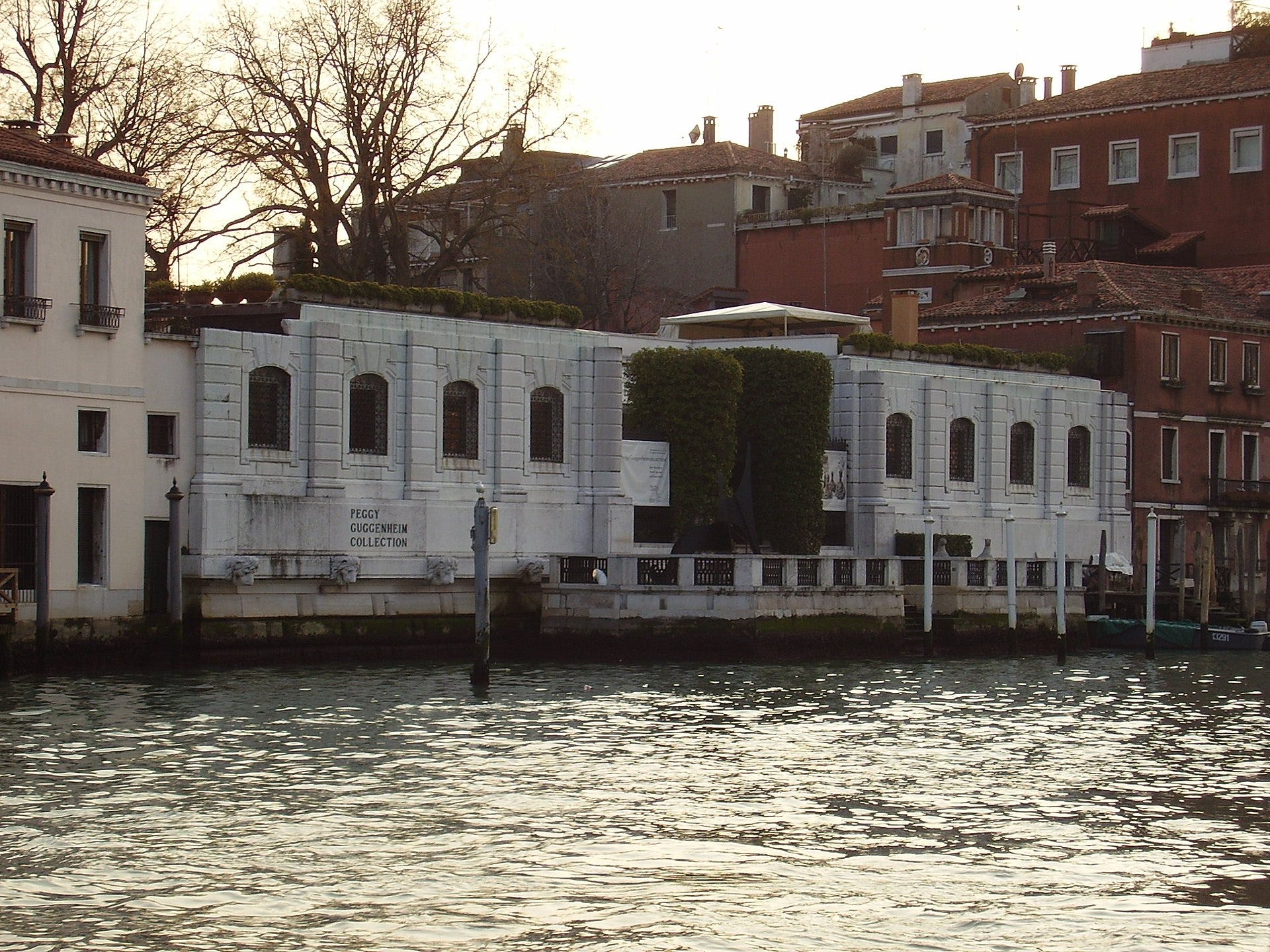
Palazzo Venier dei Leoni by Entoaggie09 via Wikimedia Commons.
Peggy Guggenheim met Luigi Einaudi, the president of Italy, at the 1948 Venice Biennale in stockings and a belt borrowed from a friend, with daisies of Murano glass the size of saucers swinging from her ears where convention called for a hat.
Behind her stood 136 works by 73 artists, installed in the Greek Pavilion by the Venetian architect Carlo Scarpa, bringing Cubism, Surrealism and American abstraction together for an Italian public emerging from Fascism and war. On the Biennale map her name sat among the sovereign states, and she wrote afterward that she felt she had become a new European country, which is a reasonable ambition for a woman arriving in Venice after a stretch of romantic administrative collapse.
By then she had fled Nazi-occupied France, crossed the Atlantic twice, closed two marriages and redirected American painting from a gallery on West 57th Street, where Art of This Century gave Pollock and Robert Motherwell their first solo shows. Hanging Pollock in Europe took nerve, and turning private taste into a public institution took years of dull administration, and romance explains very little about either.
What the art and the men had in common was her willingness to risk being wrong in public. Any woman who has negotiated a contract on Tuesday and mistaken chemistry for character on Friday knows that split. Peggy pursued both at operatic scale and refused to let either discredit the other.
Begin where she became a country
Her tenure as a European country lasted a single Biennale, but the building outlasted the arrangement. The Greek Pavilion still stands in the Giardini, where the 61st International Art Exhibition, titled In Minor Keys, runs from May 9 through November 22, 2026, and the building you enter is where Pollock’s work was shown in Europe for the first time.
More than two decades before Peggy’s Biennale exhibition, she married the writer and artist Laurence Vail in 1922, entering a Paris circle that included Constantin Brancusi, Djuna Barnes and Marcel Duchamp. Duchamp later taught her “the difference between abstract and Surrealist art” and introduced her to artists she would exhibit and collect through Guggenheim Jeune, which opened in London in 1938. She and Vail had two children, Sindbad and Pegeen, before the couple separated.
In July 1941, she left Nazi-occupied France for New York by way of Lisbon, traveling with her children, Vail and his second wife, the writer Kay Boyle, and Max Ernst, whom she married that December. Prose writes that both marriages were “filled with alcohol-fueled violence.” Peggy opened Art of This Century the following autumn and gave Pollock his first solo show in 1943, which is to say she was doing the most consequential work of her life while living through the worst years of her marriage.
The marriages ended, but the collection survived them, and seventy-eight years later it draws us back to the Greek Pavilion. In 2026, Greece has given the building to the artist Andreas Angelidakis, whose Escape Room, curated by George Bekirakis, transforms it into a contemporary Platonic cave and treats national identity as something fabricated, commercialized, and presented as truth. At the entrance stands an enormous pair of Peggy’s signature spectacles, made from chain and fitted with riot-shield lenses. In 1948, a private collection stood among the national delegations and made a woman feel like a country. In 2026, the same room asks how countries manufacture the identities they present to the world, wearing her glasses to do it.
La Biennale lists Giardini hours of 11 a.m. to 7 p.m. through September 27, shifting to 10 a.m. until 6 p.m. from September 29. For the remainder of the exhibition, it stays shut on Mondays apart from September 7 and November 16. A €30 ticket includes one entry to the Giardini and one to the Arsenale. Peggy’s own palazzo waits across the city in Dorsoduro, which is where the rest of this goes.
Give the palazzo two hours
From the Giardini, take the vaporetto to Salute and continue into Dorsoduro, where Palazzo Venier dei Leoni lies low against the Grand Canal. The Venier family ordered five stories from the architect Lorenzo Boschetti in 1749 and got one, the work stopping for reasons that remain uncertain. Peggy bought the stump of it, garden included, in 1949, and from 1951 opened the house and collection free of charge three afternoons a week from Easter to October. Its failure to rise above a single floor is what put her taste on the water, leaving modern art almost level with the traffic on the Grand Canal.
Inside, the permanent collection still carries the intimacy of rooms and the force of one woman’s decisions. Max Ernst hangs here as an artist and an ex-husband, in the palazzo she bought after the marriage ended, while Pollock earned his place because she paid him, showed him and kept saying so in public. Alexander Calder’s Silver Bedhead, commissioned in New York during the winter of 1945–46, works silver into fish, an insect and plant forms, so one of the century’s great sculptors built her a headboard, and she slept beneath it. On the terrace over the Grand Canal, Marino Marini’s The Angel of the City faces the water, and the museum’s own description ties the rider’s force to “sexual potency” without any hedging.
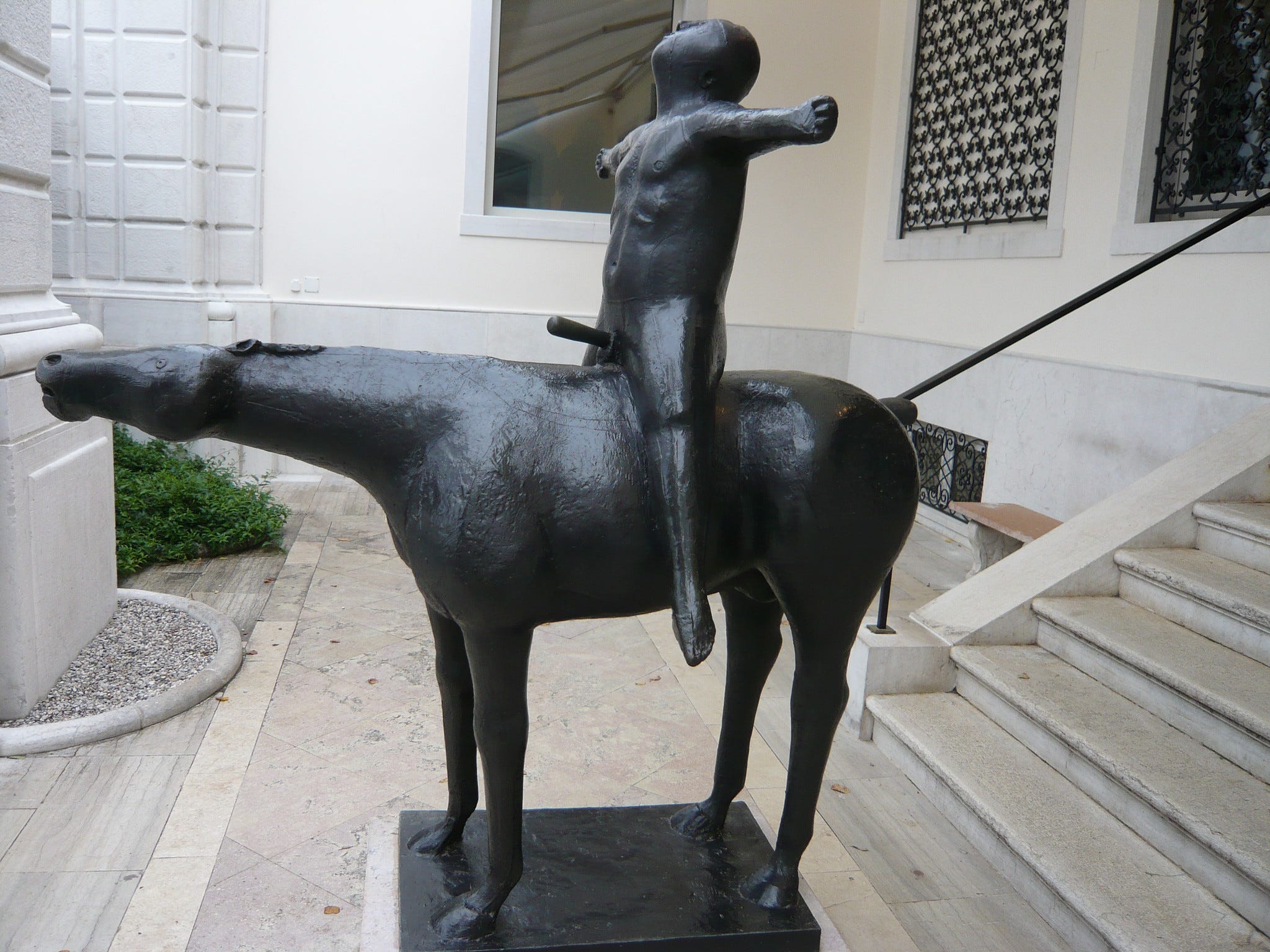
“Peggy Guggenheim Collection - Venice” by G Travels, CC BY-NC 2.0
Through October 19, the house is also showing Peggy Guggenheim in London: The Making of a Collector, which brings women Peggy exhibited at Guggenheim Jeune back into view, Rita Kernn-Larsen and Eileen Agar among them. She was giving women wall space five years before Exhibition by 31 Women opened in New York, and that show is where the cost of her generosity came due. Max Ernst was helping select its artists when he visited Dorothea Tanning’s studio and found her self-portrait still on the easel. He suggested the title Birthday, for a passage from the real into the surreal, and Peggy included it in the exhibition.
Within months of the show’s opening, Ernst and Tanning began an affair. Peggy and Ernst divorced in 1946, and he married Tanning that October. Peggy’s line afterward was that she “should have had only thirty women.” Tanning remained with Ernst until his death in 1976, continued working for decades, and published her second collection of poems in 2011, the year before she died at 101.
Peggy lived with these works for thirty years, arranging them throughout the rooms where she ate, slept, and entertained, and her ashes now rest in the garden beyond them. The four solo shows and monthly stipend she gave Pollock are the famous version of her judgment. In this building, she did it again for the Italian painter Tancredi Parmeggiani, putting him on a monthly stipend, giving him a studio in the basement and staging his solo exhibition in her own house in 1954. She ran the same play twice on two continents, with Tancredi’s exhibition opening eleven years after Pollock’s first, and Venice named her an honorary citizen in 1962.
Buy the Earrings and Save Dinner Money
For lunch, walk inland to Enoteca Ai Artisti, a small canal-side room on Fondamenta Toletta, where the kitchen cuts cuttlefish into ribbons and sends out house pasta with butter, anchovies and blueberry sauce. Book ahead, then save the dinner money for somewhere less interesting.
Double back toward Campo San Vio to Marina e Susanna Sent, whose glass jewelry makes a good contemporary answer to Peggy’s habit of wearing the argument. Yves Tanguy gave her a pair of tiny paintings on shell in 1938, and at the opening of Art of This Century she wore one of them alongside an earring by Alexander Calder to declare equal allegiance to Surrealism and abstraction. Wearing rival movements on separate ears is an editorial position, and she knew it.
Walk to Punta della Dogana. A paid Guggenheim ticket currently brings admission there and at Palazzo Grassi down from €20 to €15 for seven days.
Give Harry’s Bar One Drink
Take the vaporetto from Salute to San Marco and go into Harry’s Bar, which opened in 1931 and still lists Peggy among its famous patrons. Peggy’s palazzo guest book places the young Beat poet Gregory Corso there in January 1958 but stops short of seating him beside her at Harry’s, although the timing makes the scene easy to imagine. He left a drawing and poem in its pages. That same month, Al Hirschfeld depicted Peggy at Harry’s wearing her Calder earrings and biting into a sandwich.
Francine Prose describes Peggy’s bond with Corso as sweet, although whether it became sexual remains uncertain. More than thirty years separated them, and theirs was one of those connections in which the affection is clearer than the label.
Order one Bellini, take in the polished wood, low ceiling and close-set tables, and leave before the room persuades you into dinner. What you buy at Harry’s is admission, served as Prosecco and white-peach purée.
Cross the Piazza for Pollock
Across Piazza San Marco, the Ala Napoleonica of the Museo Correr holds another piece of Peggy’s history. In 1950 she organized Pollock’s first solo exhibition in Europe there, two years after introducing his work to Europe at the Giardini. The paintings have gone, but the address still gives the measure of her conviction.
Sleep Beside the Salute
For the nights around all this, Ca’ Maria Adele has twelve rooms beside the Basilica della Salute, a few minutes from Peggy’s palazzo. Few women understood better that a beautiful address and a successful relationship are separate acquisitions. After the literary critic John Ferrar Holms, her lover of six years, died during a routine operation in 1934, she tried conventional domesticity with the Communist writer Douglas Garman at Yew Tree Cottage near Petersfield, an experiment The Guardian revisited in 2024 and one familiar to anyone who has opened a property app in the middle of a bad year.
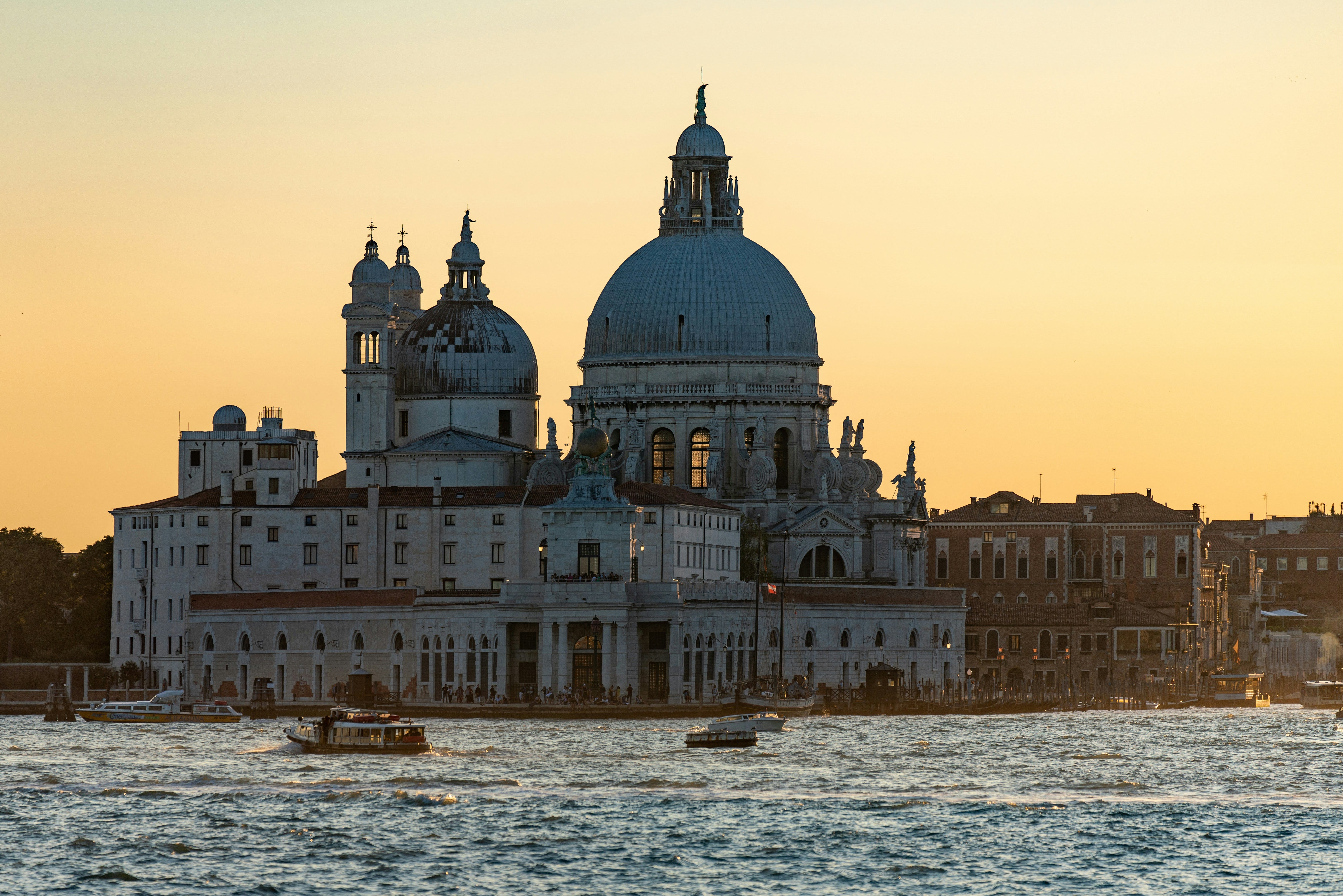
Photo by Claudio Schwarz on Unsplash
The Garman relationship also ended. Peggy later called the notion of Venice as the ideal honeymoon city a “grave error,” since the city takes the whole heart and leaves nothing for anyone else. Venice returns whatever you brought and enlarges it. Arrive settled, and Venice is generous. Arrive in pieces, and it holds a mirror very close. Ca’ Maria Adele is a reasonable place to find out which one you are.
End in the Garden
Peggy spent the final thirty years of her life in the palazzo and, in death, kept the address. Her ashes rest in one corner of the sculpture garden beside a slab reading “Here Lie My Beloved Babies,” followed by the names and dates of fourteen dogs. The men occupy hundreds of pages in her memoir. The dogs got the stone next to hers.
Addresses to Save
Biennale Arte 2026
Giardini entrance at Viale Trento, Castello 1260. Arsenale entrance at Campo de la Tana, Castello 2169/F. Open through November 22, 2026. Closed Mondays, except September 7 and November 16.Peggy Guggenheim Collection
Palazzo Venier dei Leoni, Dorsoduro 701. Open daily from 10 a.m. to 6 p.m. Closed Tuesdays. Tickets are available online and at the museum.Enoteca Ai Artisti
Fondamenta Toletta, Dorsoduro 1169/ABC. Open Tuesday through Saturday from 12:45 to 2:45 p.m. and from 7 to 10 p.m. Closed Sundays and Mondays. Reserve ahead.Marina e Susanna Sent
Campo San Vio, Dorsoduro 669 and 681. Check the current opening schedule directly with the shop.Punta della Dogana
Dorsoduro 2, beside the Basilica di Santa Maria della Salute. Open during exhibition periods from 10 a.m. to 6 p.m. Closed Tuesdays.Ca’ Maria Adele
Dorsoduro 111, beside the Basilica di Santa Maria della Salute. Reserve directly with the hotel.Harry’s Bar
San Marco 1323. Open daily from 11 a.m. to 11 p.m.Museo Correr
San Marco 52, with public access through the Ala Napoleonica in Piazza San Marco. Open daily from 10 a.m. to 6 p.m. On Fridays and Saturdays through September 26, 2026, it remains open until 11 p.m.